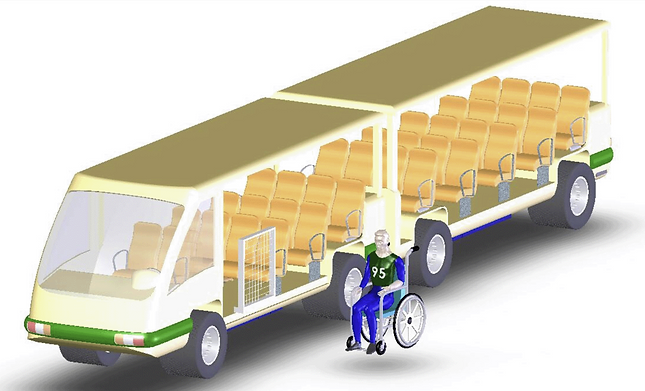
Patuxent Wildlife Refuge Tram
When visiting a park or refuge people have an expectation of clean air and respect for the environment. Patuxent wildlife refuge meets this expectation by providing its visitors with, among other things, an interpreted tour aboard a zero emissions electric tram.
Located in Silver Spring, between Washington DC and Baltimore Patuxent is in an ideal location to showcase technology demonstrators as well as convey the refuges message. Tram tours highlight the research and habitat management programs of the U.S. Fish and Wildlife Service, promote the appreciation of wildlife and natural resources, and promote public stewardship of the environment. Tours for school classes focus on age-appropriate educational material that ties to State and National educational curricula. Tours are not only educational, and an excellent way to inform the public about natural resource conservation missions, but they are recreational as well and fun. Tram tours are probably Patuxent’s single most valuable means of communicating important conservation messages to the public, and are one of the most enjoyed educational/recreational experiences on the refuge. Patuxent estimates that approximately 10,000 visitors take advantage of tram tour opportunities each year.
The tour route used is a narrow dirt/gravel road which winds through forest, meadow and wetland habitat areas. Being all-electric, the tram is non-polluting and quiet; and is an excellent venue from which visitors can observe wildlife in their natural habitats. The tram generates awareness of alternative vehicles and showcases some of the unique attributes of electric vehicles. The wildlife has become accustom to seeing the vehicle, and it is much less invasive and has less impact on the environment than other vehicles or hikers.
The tram was donated by research consortium called Electricore and the department of defense in 1994 as part of a DARPA (Defense Advanced Research Project Agency) program aimed at evaluating quiet electric transportation in off-road conditions. The tram chassis was designed by Specialty Vehicles Corp. originally as a gasoline powered vehicle. GM provided Specialty Vehicle with a prototype EV1 drive train and power electronics which they subsequently installed. Over the years the aging prototype components needed more and more attention and technical support; which was increasingly hard to come by. A research development corporation, Maritime Applied Physics Corp., replaced the components with a direct current system in 1999. The key drivers in the selection of a DC drive train were reliability, operational speed and torque envelope, and cost. The tram while it was developed as a prototype has been in operation for over thirteen years. The aging chassis and components have driven Patuxent to seek a replacement.
In 2001 legislation was enacted that began to investigate the overall transportation systems for parks and public lands. An “Alternative Transportation for Parks and Public Lands” program developed under the SAFETEA-LU legislation provides ~$22M/year for finding more efficient, less polluting ways to move people around our national parks. This legislation could be the stepping stone for developing alternative fueled vehicles to move people around our public parks. There have been several acts established in recent years focused on the viability of alternative fuels, the reduction of imported petroleum, and the reduction of vehicle emissions. At a time when fuel costs are skyrocketing and alternative energy solutions are needed, projects like the Patuxent tram are becoming more attractive. The innitial design and development costs of an electric vehicle are slightly higher than a conventional internal combustion vehicle; however these costs can be justified when you look at the long term energy and environmental needs. The time has come to develop a national program directed at fostering environmentally conscious vehicles to ensure that our national resources as well as our parks are preserved for generations to come.